Snapdragon SoC Architecture
Snapdragon Mobile Processor is a heterogeneous SoC where CPU, GPU, NPU, ISP and connectivity are tightly coupled through high bandwidth interconnects to deliver performance per watt and real time experiences.
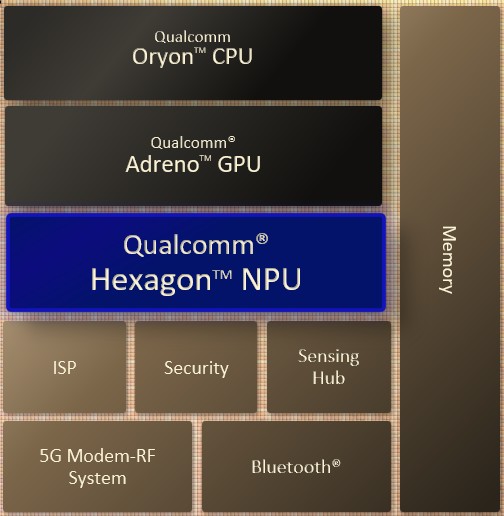
1. Qualcomm® Oryon™ CPU
Role: General purpose processing & system control
Qualcomm Oryon CPU is a custom-built CPU architecture designed by Qualcomm for high performance and high efficiency mobile computing. It handles:
Application execution (Android framework, apps, services)
System scheduling and OS control
Control logic for camera, AI, graphics, and connectivity pipelines
2. Qualcomm® Adreno™ GPU
Role: Graphics rendering & parallel compute
The Adreno GPU is Qualcomm’s in house graphics processor, responsible for:
UI composition and display rendering
Advanced mobile gaming (Vulkan, OpenGL ES)
GPU compute for graphics adjacent workloads
Hardware accelerated ray tracing and gaming features
3. Qualcomm® Hexagon™ NPU
Role: AI & Machine Learning acceleration
The Hexagon NPU (Neural Processing Unit) is Qualcomm’s dedicated AI engine, optimized for:
Neural network inference - On device generative AI - Computer vision and speech processing - Sensor driven AI workloads
Qualcomm explains that Hexagon combines tensor, vector, and scalar accelerators in a fused architecture, enabling efficient execution of AI models with lower power consumption compared to CPU or GPU execution.
4. Qualcomm® Spectra™ ISP (Image Signal Processor)
Role: Camera & Imaging Processing
The Spectra ISP is Qualcomm’s dedicated camera processing block. It processes raw sensor data and performs:
Demosaicing and noise reduction
Auto exposure, auto white balance, autofocus
Multi frame HDR and Night Vision
AI assisted image enhancement (via Hexagon)
5. Qualcomm® Sensing Hub
Role: Low-power always-on contextual awareness & sensor processing
The Qualcomm Sensing Hub is a dedicated, low-power subsystem designed to efficiently process continuous data streams from various sensors and peripherals without waking the main CPU. It handles:
Always-on sensor algorithms (e.g., pedometer, activity recognition, motion and elevator detection)
Always-on audio processing for seamless voice wake-up, keyword detection, and audio context awareness
Always-Sensing Camera (ASC) workloads for ultra-low-power face detection and vision tasks
Supplying machine learning inputs and contextual data to proactive on-device AI assistants
6. Qualcomm® Connectivity Subsystem
Role: Connectivity
Snapdragon mobile platforms integrate cellular and short range connectivity directly into the SoC through the Snapdragon Modem RF system and FastConnect™ subsystems.
Cellular: 5G modem and RF transceivers
FastConnect subsystem: Wi Fi, Bluetooth, and Ultra Wideband (UWB)