aimet_onnx.quantsim
Note
It is recommended to use onnx-simplifier before creating quantsim model.
- class aimet_onnx.QuantizationSimModel(model, *, param_type=int8, activation_type=int8, quant_scheme=QuantScheme.min_max, config_file=None, dummy_input=None, user_onnx_libs=None, providers=None, path=None, session_options_kwargs=None)[source]
Class that simulates the quantized model execution on a target hardware backend.
- Parameters:
model (
ModelProto) – ONNX ModelProto to quantizeparam_type (
Union[str,qtype]) – quantized type to use for parameter tensors. Can be { int2, int4, int8, int16, float16, float32, float8e4m3fn, float8e5m2 } oraimet_onnx.qtypeactivation_type (
Union[str,qtype]) – quantized type to use for activation tensors. Can be { int2, int4, int8, int16, float16, float32, float8e4m3fn, float8e5m2 } oraimet_onnx.qtypequant_scheme (
Union[str,QuantScheme]) – Quantization scheme to use for calibration. Can be { min_max, tf_enhanced } orQuantSchemeconfig_file (
Optional[str]) – File path or alias of the configuration file. Alias can be one of { default, htp_v66, htp_v68, htp_v69, htp_v73, htp_v75, htp_v79, htp_v81, htp_v85, enpu_v6, enpu_v7 } (Default: “default”)dummy_input (
Optional[Dict[str,ndarray]]) – Sample input to the model. Only needed for non shape-inferable models with parameterized shapesuser_onnx_libs (
Optional[List[str]]) – List of paths to all compiled ONNX custom ops librariesproviders (
Optional[Sequence[Union[str,Tuple[str,Dict[Any,Any]]]]]) – Onnxruntime execution providers to use when building InferenceSession. If None, default provider is “CPUExecutionProvider”path (
Optional[str]) – Directory to save temporary artifacts.session_options_kwargs (
Optional[Dict[str,Any]]) – Attributes to set on the sim’sonnxruntime.SessionOptions(e.g.{"intra_op_num_threads": 2}). An unknown attribute name raises AttributeError.
- compute_encodings(*args, **kwargs)[source]
Computes encodings for all quantizers in the model.
- Overloads:
inputs (
Iterable[Dict[str,ndarray]])forward_pass_callback (
Callable[[InferenceSession],Any])forward_pass_callback (Callable[[ort.InferenceSession, T], Any]), forward_pass_callback_args (T)
This API will invoke forward_pass_callback, a function written by the user that runs forward pass(es) of the quantized model with a small, representative subset of the training dataset. By doing so, the quantizers in the quantized model will observe the inputs and initialize their quantization encodings according to the observed input statistics.
This function is overloaded with the following signatures:
- compute_encodings(inputs)[source]
- Parameters:
inputs (Iterable[Dict[str, np.ndarray]]) – The set of model input samples to use during calibration
- compute_encodings(forward_pass_callback)[source]
- Parameters:
forward_pass_callback (Callable[[ort.InferenceSession], Any]) – A function that takes a quantized model and runs forward passes with a small, representative subset of training dataset
- compute_encodings(forward_pass_callback, forward_pass_callback_args)[source]
- Parameters:
forward_pass_callback (Callable[[ort.InferenceSession, T], Any]) – A function that takes a quantized model and runs forward passes with a small, representative subset of training dataset
forward_pass_callback_args (T) – The second argument to forward_pass_callback.
Example
>>> sim = QuantizationSimModel(...)
>>> def run_forward_pass(session: ort.InferenceSession):
...     for input in dataset:
...         _ = sess.run(None, {"input": input})
...
>>> sim.compute_encodings(run_forward_pass)
- export(path, filename_prefix, export_model=True, *, export_int32_bias=None, encoding_version=None, force_activation_as='unsigned')[source]
Compute encodings and export to files
- Parameters:
path (
str) – dir to save encoding filesfilename_prefix (
str) – filename to save encoding filesexport_model (
bool) – If True, then ONNX model is exported. When False, only encodings are exported.export_int32_bias (
Optional[bool]) – If true, generate and export int32 bias encoding on the fly. Default: True if encoding version is 2.0.0 or higher, otherwise False.encoding_version (
Optional[str]) – Version of the encoding format to use. (default: 1.0.0) Supported versions are: [‘0.6.1’, ‘1.0.0’, ‘2.0.0’, ‘2.1.0’]force_activation_as (
Union[Literal['unsigned'],Literal['signed'],None]) – Force representing quantized activations as signed or unsigned integers. This argument is only applicable for encoding version 2.0.0. For versions 0.6.1 and 1.0.0, this argument is ignored. (default: “unsigned”)
Example
>>> sim.export(path=".", filename_prefix="model", encoding_version="2.0.0")
- classmethod from_onnx_qdq(model, strict=False, **kwargs)[source]
Create sim from an ONNX QDQ model that contains QuantizeLinear/DequantizeLinear nodes.
This method is designed to construct a fully quantized model based on a partially quantized ONNX QDQ model exported from aimet-torch (
aimet_torch.onnx.export()) or other 3rd party tools.- Parameters:
model (
ModelProto) – ONNX model that contains QuantizeLinear/DequantizeLinearstrict (
bool) – If True, raises error if there are QuantizeLinear/DequantizeLinear nodes in the model that cannot be mapped to any quantizer in the sim. If False, ignores incompatible QuantizeLinear/DequantizeLinear nodes and only loads the rest of the encodings. (Default: False)**kwargs – same as QuantizationSimModel.__init__
- Returns:
QuantizationSimModel created from ONNX QDQ model
- Return type:
Example
>>> sim = aimet_onnx.QuantizationSimModel.from_onnx_qdq(
...     onnx.load("model_qdq.onnx"),
...     config_file="htp_v81",
... )
Quant - INFO - Loaded 26 out of 63 encodings from QuantizeLinear/DequantizeLinear nodes
- set_tensor_precision(names, precision, *, strict=True)[source]
Set the quantization precision for each tensor in names to the specified precision
If quantization is not performed directly on the specified tensor (e.g., for outputs of data movement ops), propagates upwards to the closest enabled quantizer.
Example
sim = QuantizationSimModel(…) sim.set_tensor_precision(“/Conv_output_0”, aimet_onnx.int16)
- Parameters:
names (
str|list[str]) – List of tensor names to set the precision forprecision (
qtype|str) – Precision to quantize to. If string, must be a valid alias of a qtypestrict (
bool) – If True, throws an error if the tensor does not exist or is not quantized
- to_onnx_qdq(*, export_int32_bias=False, prequantize_constants=False, force_activation_as='unsigned')[source]
Return a copy of ModelProto with all QcQuantizeOp nodes replaced with QuantizeLinear and/or DequantizeLinear.
Example
>>> len([qc_op for qc_op in sim.model.nodes() if dq.op_type == "QcQuantizeOp"])
10
>>> onnx_qdq = sim.to_onnx_qdq()
>>> len([qc_op for qc_op in sim.model.nodes() if dq.op_type == "QcQuantizeOp"])
0
>>> len([dq for dq in onnx_qdq.graph.node if dq.op_type == "DequantizeLinear"])
10
- Parameters:
export_int32_bias (
bool) – If true, generate and export int32 bias encoding on the fly (default: True)prequantize_constants (
bool) – If True, weights will be represented as quantized weight followed by DequantizeLinear nodes. If False, weights will be represented as float tensors followed by QuantizeLinear and DequantizeLinear nodes.force_activation_as (
Union[Literal['unsigned'],Literal['signed'],None]) – Force representing quantized activations as signed or unsigned integers (default: “unsigned”)
- Return type:
ModelProto
Note
FP8 (
float8e4m3fn/float8e5m2) quantizers are exported as onnx::QuantizeLinear/DequantizeLinear with a float8y_zero_pointof 0, which requires opset >= 19. The opset is raised automatically when needed.Such a model must be run with an onnxruntime graph optimization level of at most
ORT_ENABLE_BASIC. FromORT_ENABLE_EXTENDEDupward, onnxruntime fuses QDQ pairs into integer kernels such asQLinearConv, which do not accept float8 inputs and cause session creation to fail with “Type ‘tensor(float8e4m3fn)’ … is invalid”.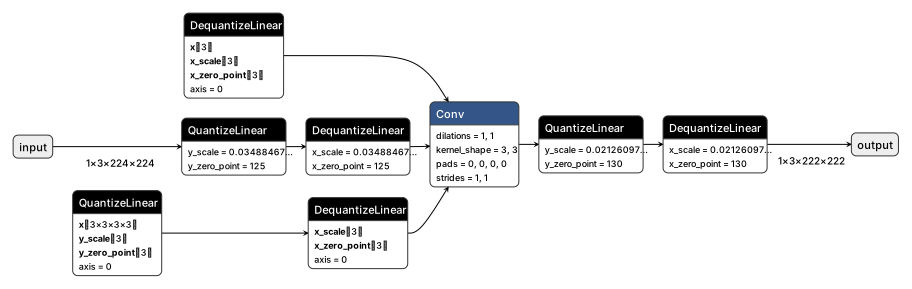
- aimet_onnx.compute_encodings(sim)[source]
Computes encodings for all quantizers in the model.
Under this context manager,
QuantizationSimModelwill observe all inputs that run through the model to calibrate the quantization encoding of each quantizer.Example
>>> sim = QuantizationSimModel(...)
>>> with compute_encodings(sim):
...     for input in dataset:
...         _ = sim.session.run(None, {"input": input})
- aimet_onnx.encodings_to_onnx_qdq(model, encodings, *, prequantize_constants=False, force_activation_as='unsigned')[source]
Convert an ONNX model and its AIMET encodings into an ONNX QDQ model.
This is a direct translation: the encodings determine exactly which tensors are quantized and how. No
QuantizationSimModelis created, so no quantsim configuration (supergroups, op tying, encoding constraints) can add or remove quantizers relative to what the encodings specify.[b]float16 is not a quantized data type and onnx QDQ has no representation for it, so plain-cast float encodings are omitted with a warning, whether they name a parameter or an activation. Scaled float formats such as FP8 do carry a scale, and are emitted as Q/DQ.
An encoding naming a tensor that is not in the model is an error.
- Parameters:
model (
ModelProto|ONNXModel|str) – ONNX model as aModelProtoorONNXModel, or a path to one. The model is not modified in place.encodings (
dict|str) – AIMET encodings as a dict, or a path to an encodings file. Versions 0.6.1, 1.0.0, 2.0.0, and 2.1.0 are accepted.prequantize_constants (
bool) – If True, store quantized parameters as integer initializers rather than emittingQuantizeLinearfor them. (default: False)force_activation_as (
Optional[Literal['unsigned','signed']]) – Cast all activation encodings to signed or unsigned, a workaround for QNN converter limitations. Pass None to leave them as-is. (default: “unsigned”)
- Return type:
ModelProto- Returns:
The equivalent ONNX QDQ model.
Examples
>>> qdq_model = encodings_to_onnx_qdq("model.onnx", "model.encodings")
>>> onnx.save_model(qdq_model, "model_qdq.onnx")
- aimet_onnx.quantsim.set_param_type(sim, param_type, **kwargs)[source]
Set parameter quantization data type for specified layers.
- Overloads:
sim (
QuantizationSimModel), param_type (QSpec|qtype|str), *, op_types (Union[Tuple[str],str,None]) =None, nodes_to_exclude (Optional[Set[str]]) =None, strict (bool) =True, shift_zero_point (bool) =Falsesim (
QuantizationSimModel), param_type (QSpec|qtype|str), *, nodes_to_include (Optional[Set[str]]) =None, strict (bool) =True, shift_zero_point (bool) =False
This function is overloaded with the following signatures:
- aimet_onnx.quantsim.set_param_type(sim, param_type, *, nodes_to_include=None, strict=True, shift_zero_point=False)[source]
- Parameters:
sim (QuantizationSimModel) – Quantsim to set param type for
param_type (QSpec | qtype | str) – Quantization data type to set for the parameters
nodes_to_include (Set[str]) – Set of onnx node names for which to set parameter quantization data type. If None, all nodes are included
strict (bool) – If False, skip quantizers incompatible with
param_type.shift_zero_point (bool) – (Deprecated) Whether to shift the quantizer’s zero point (only for int2 param type).
- aimet_onnx.quantsim.set_param_type(sim, param_type, *, nodes_to_include=None, strict=True, shift_zero_point=False)[source]
- Parameters:
sim (QuantizationSimModel) – Quantsim to set param type for
param_type (QSpec | qtype | str) – Quantization data type to set for the parameters
op_types (Set[str]) – Set of onnx op types for which to set parameter quantization data type. If None, all types are included
nodes_to_exclude (Set[str]) – Set of onnx node names to exclude for setting parameter quantization data type
strict (bool) – If False, skip quantizers incompatible with
param_type.shift_zero_point (bool) – (Deprecated) Whether to shift the quantizer’s zero point (only for int2 param type).
Examples
>>> sim = QuantizationSimModel(...)
>>> # Set all parameter quantizers to int8 data type
>>> set_param_type(sim, aimet_onnx.int8)
>>> # Set parameter quantizers of Conv, MatMul, and Gemm layers to int4 data type
>>> set_param_type(sim, aimet_onnx.int4, op_types={"Conv", "MatMul", "Gemm"})
>>> # Set parameter quantizers of "/lm_head/MatMul" to int2 with shifted zero point
>>> spec = aimet_onnx.QSpec.blockwise(int2, block_size=64, symmetric=True, shift_zero_point=True)
>>> set_param_type(sim, spec, nodes_to_include={"/lm_head/MatMul"})
>>> # Set parameter quantizers of "/lm_head/MatMul" to LPBQ
>>> spec = aimet_onnx.QSpec.lpbq(int4, block_size=64)
>>> set_param_type(sim, spec, nodes_to_include={"/lm_head/MatMul"})
Quantization Spec
- class aimet_onnx.QSpec(dtype, granularity=None, symmetric=None, shift_zero_point=False)[source]
Specifies how a tensor should be quantized (precision and granularity).
- Parameters:
dtype (
qtype) – Quantized data typegranularity (
Optional[Granularity]) – How quantization parameters are shared across the tensorsymmetric (
Optional[bool]) – If specified, determines whether encodings will be symmetricshift_zero_point (
bool) – Whether to shift quantizer’s 0 point by a half-step. Only supported for int2 param quantizers
- classmethod blockwise(dtype, block_size, *, symmetric=None, shift_zero_point=False)[source]
Constructs a blockwise QSpec
- Return type:
- classmethod lpbq(dtype, block_size=64, scale_bits=4)[source]
Constructs a low-power blockwise QSpec
- Return type:
Quant Scheme Enum